N-Series offers the N-DR1 Digital Dual Channel Receiver, designed with ease-of-use in mind and packed with high-end functionality.
True Radio Diversity
The N-DR1 Digital Dual Channel Receiver is based on a true diversity set-up, also known as radio diversity, where the two antennas are internally hooked up to two radio circuitries. Each antenna input has its own radio. This differs from systems that offer antenna-diversity where there is only one built-in radio which must shift between the two antennas.
Dante Digital standard
The N-DR1 Digital Dual Channel Receiver is equipped as standard with a Dante output. This output features the ability to run both a single connection and in true redundancy, i.e. Primary/Secondary set-ups for highest security.
We encourage users of the system to stay in the digital domain, using the Dante output, to avoid signal degradation. Every time the signal is converted from digital to analog and back again, there is signal loss as well as added latency.
Protection and privacy
The N-Series takes security of data seriously, offering AES256 encryption for privacy, which is paramount when using a wireless system in a corporate or governmental environment.
Amazing channel packing
The number of channels that any system can pack depends on the availability of availability of spectrum, but in an ideal world with no governmental restrictions and disturbing TV channels or radio frequency transmitting systems, the DPA wireless system can reach a stunning 800 possible channels.
In practical terms a user is limited to the allowed slots given in the specific area where the equipment is being used. Due to this you can rest assured that you can always find a free spot for your DPA wireless mics to operate in.
The system has an equal distance ability meaning that each channel needs 500 kHz spacing to the next channel. This is without Inter Modulation Distortion (IMD) components between the transmitters.
Minimal latency
The small delay that is always present with digital wireless systems is just below 3 milliseconds (2.9 ms) for the N-Series.
Product Id
N-DR1 - N-Series Dual Channel Digital Wireless Receiver w. DANTE Output, 870 MHz
Specifications
N-DR1 Dual Channel Digital Wireless Receiver
RF Frequency Range470 - 870 MHz (Varies by region)
RF Input Impedance50 Ω
RF Tuning Steps25 kHz
RF Sensitivity-96 dBm at 10^-5 BER
Audio PolarityPositively increasing sound pressure produces positive going voltage on relevant audio outputs
Working Range100 m (330 ft) Range depends on the RF enviroment, i.e. absorption, reflection and interference
Audio Dynamic Range (system) analog126 dB
Audio Dynamic Range (system) Digital126 dB
Audio Frequency Response20 - 20 kHz (±1 dB)
Latency<2.9 ms
Dante InterfacePrimary / Secondary on separate connectors from Control Network
Housing TypeSteel and Aluminium
Operating Temperature-10°C to 50°C (14°F to 122°F)
Storage Temperature-20°C to 50°C (4°F to 122°F) Without batteries installed
Digital Audio Trim-20 dB to +40 dB on the receiver side, selectable in increments of 1 dB
Dimension (H x W x D)44 mm (1.7 in) x 482 mm (19.0 in) x 246 mm (9.7 in)
Weight3,6kg (7.9 lb)
RF Input Bias Voltage12 volts, max 250 mA per antenna
RF Input Connector typeBNC
Dante Sample Rates44.1 kHz, 48 kHz, 88.2 kHz, 96 kHz
Network InterfaceSwitched (dual port) Ethernet, max 100 Mbps
Network AddressingDHCP or Manual IP
Analog Output Impedance66 Ω (Only applicable for Receivers with Analog Outputs)
Analog Output Signal LevelSwitchable Line or Mic (-30 dB pad) (Only applicable for Receivers with Analog Outputs)
Analog Audio Reference0 dBu to 20 dBu for full scale output, selectable in increments of 1 dB (Only applicable for Receivers with Analog Outputs)
Supply Voltage, Autosensing100VAC - 240VAC
Power, Max28 W
ColorsBlack, Matte black
Key Features
Wideband – 470 - 870 MHz bandwidth in each unit
Sleek front panel design offers an easy overview of features
LAN control with built-in switch for loop through
Dante® Switched and Redundancy modes
Antenna inputs with power for active antennas and active loop through
Analog output (optional)
126 dB true dynamic range
 (585) 405-4375
 contact@echotonemusic.net





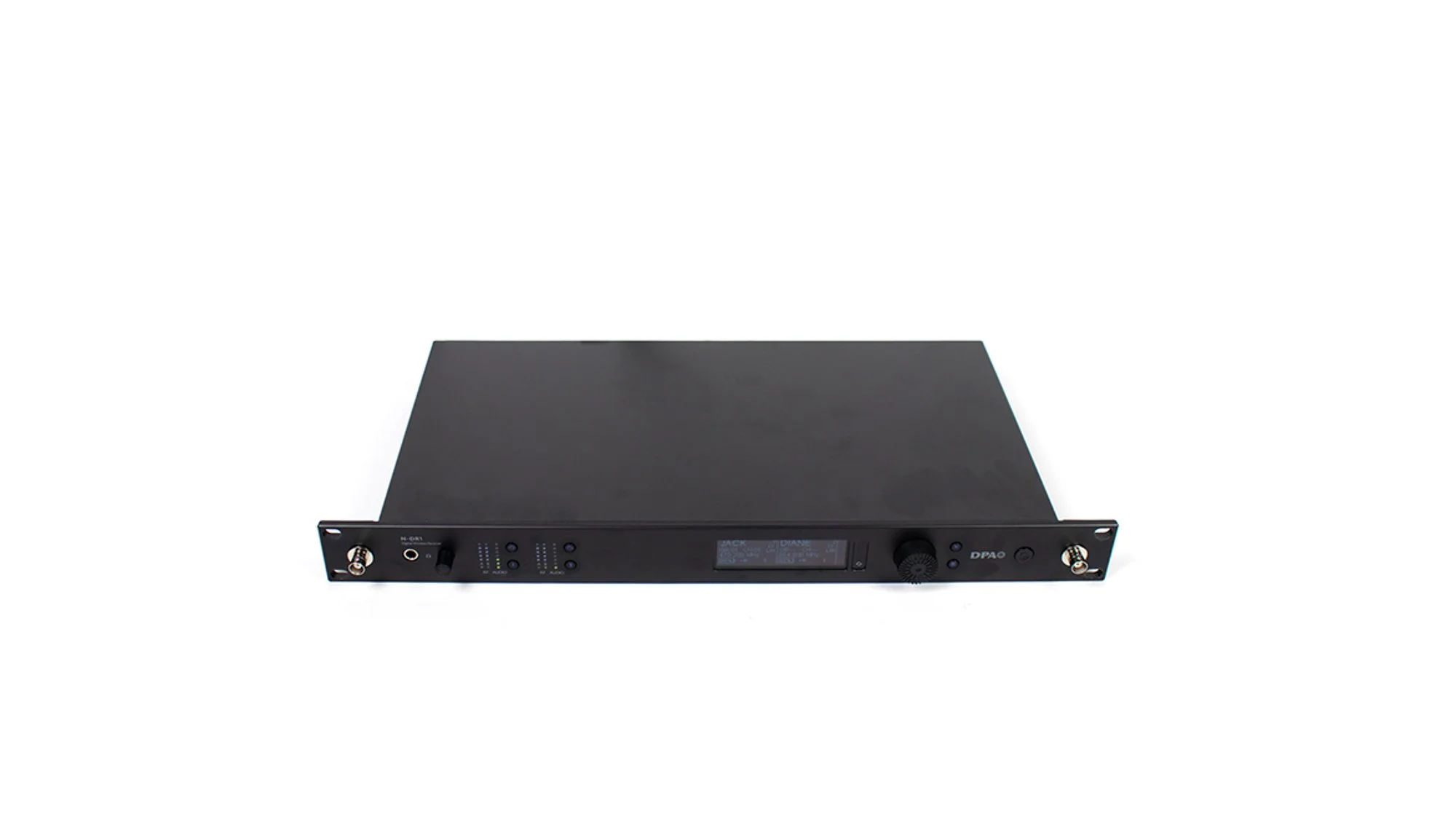 Image 1 of 1